
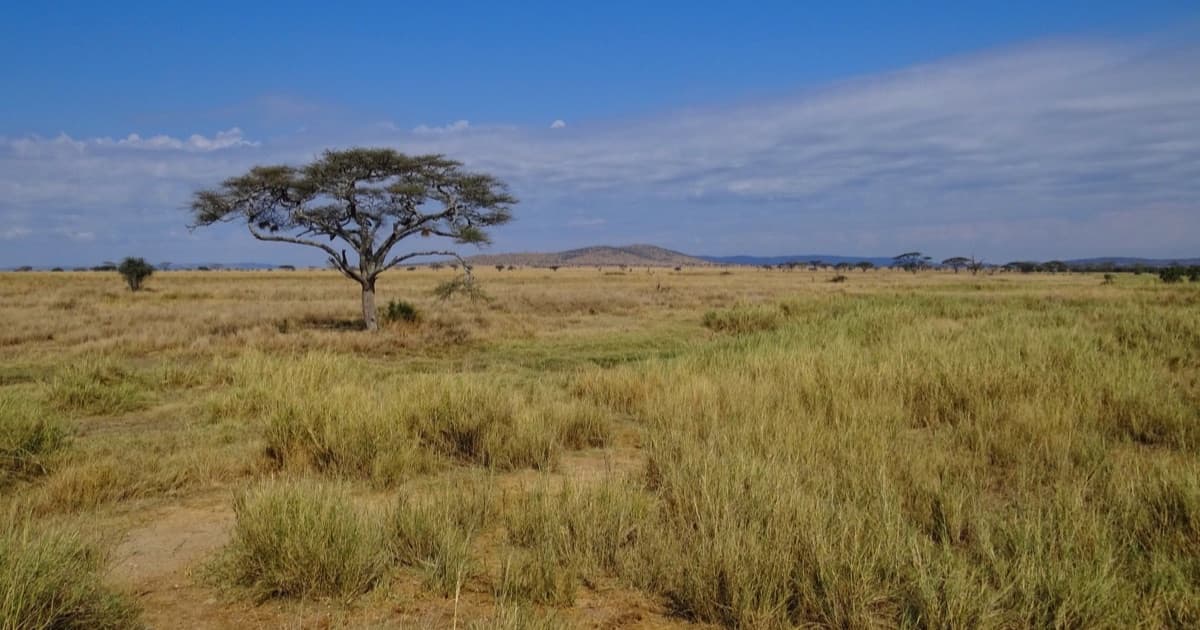
When is the Great Migration in Tanzania?
The Great Migration is a year-round event — the herds never leave Tanzania entirely. What changes month by month is which phase of the cycle you witness and where in the Serengeti ecosystem the animals are concentrated. The three headline experiences are: calving season (January–March, southern Serengeti), Grumeti River crossings (June–July, western corridor), and Mara River crossings (July–October, northern Serengeti). Each is spectacular in a completely different way.
The herds move with rainfall, not with the calendar. The dates below are averages based on decades of observation. An early rainy season can push the herds north by two to three weeks; a late rainy season holds them south longer. No guide, camp, or operator can guarantee the herds will be in a specific location on a specific date.
The full migration cycle: where the herds are each month
January — Southern Serengeti and Ndutu The herds are concentrated on the short grass plains of the southern Serengeti and the Ndutu area, which straddles the boundary between the Serengeti and the Ngorongoro Conservation Area. Calving begins in January. The grass here is nutrient-rich from the short rains, which is why the herds gather — calving on open ground with good visibility lets mothers spot predators early. Up to 500,000 calves will be born over the next six to eight weeks.
February — Southern Serengeti and Ndutu (calving peak) February is the peak of calving season. Over 80% of fertile female wildebeest drop their calves within a few weeks of each other — a strategy that overwhelms predators through sheer numbers. An estimated 500,000 calves are born in a concentrated window around mid-February. Cheetahs, lions, leopards, wild dogs, and hyenas are all highly active. This is arguably the most intense predator-prey action available anywhere in the Serengeti ecosystem, and it happens with far fewer visitors than the August river crossings.
The Ndutu Safari Lodge sits at the heart of this calving area and is one of the best-positioned properties in Tanzania for February game drives. Ngorongoro-area camps also give excellent access to the southern plains during this period.
March — Southern Serengeti to central transition The long rains begin arriving around mid-March, signalling the herds to start moving north. Calving continues in the south through early March. By late March the leading edge of the migration is pushing into the central Serengeti. This transitional period offers a mix of calving-season drama in the south and moving columns of animals through the central plains — excellent and significantly underpriced compared to peak season.
April — Central Serengeti Long rains across most of Tanzania. The herds spread through the central Serengeti, moving steadily north and west. Game viewing requires patience — the rain itself is rarely a problem during drives (African rain typically arrives in short bursts), but some tracks become muddy. Lodge rates drop sharply. Experienced safari-goers who visit in April specifically enjoy near-empty parks and intimate wildlife encounters without another vehicle in sight.
May — Central and Western Serengeti The herds continue moving northwest, following the grass regenerated by the rains. The western corridor begins filling as the leading columns approach the Grumeti River. May is one of the quietest months in the Serengeti — very few tourists, significant lodge discounts, and the extraordinary experience of watching a landscape of millions of animals in transition. Not recommended for first-time visitors, but exceptional for return visitors who know what they're doing.
June — Western Serengeti and Grumeti River The dry season begins and the Grumeti River crossings start. The Grumeti receives far less attention than the Mara crossings, but the drama is equally real — massive Nile crocodiles have been resident in the Grumeti for decades and the crossings are unpredictable and violent. The western corridor is less developed and less crowded than the north. Camps like Dunia Camp and Grumeti River Camp are well positioned for this phase. Prices start rising as the dry season begins.
July — Northern Serengeti and first Mara crossings The herds push into the northern Serengeti. July marks the start of the Mara River crossing season. Early July crossings tend to be sporadic — the herds test the river, sometimes turning back multiple times before committing. By late July, major crossings begin. This is also when camp availability in the northern Serengeti starts tightening sharply. Book at least six months ahead for July northern Serengeti accommodation.
August — Northern Serengeti (peak crossings) August is generally considered the peak crossing month. The largest concentrations of wildebeest are in the northern Serengeti and parts of the Maasai Mara (Kenya). River crossings can happen multiple times per day. Crocodiles are visible and active. The atmosphere at a major crossing — the noise, the smell, the chaos of thousands of animals piling into a river — is unlike anything else in wildlife viewing. Camps along the Mara River are at maximum capacity and charge peak-season rates. This is the most expensive and most crowded month for Tanzania safari travel.
September — Northern Serengeti Crossings continue through September with only slightly fewer crowds than August. The animals spend time on both sides of the Mara River, making multiple crossings in both directions. The grass in the north is being grazed down, which means the herds will begin looking south again as October approaches. September is the sweet spot for those who want crossing-season wildlife without August's peak pricing — slightly lower rates, same crossings.
October — Northern Serengeti and southward shift The Mara crossings taper off through October as the herds begin their return journey south. The northern Serengeti is still active but the leading edge of the return migration has already reached the central Serengeti. Tarangire National Park reaches its annual peak in October — separate from the Migration but worth noting for any October itinerary, as elephant herds of 200–300 animals concentrate along the Tarangire River.
November — Central Serengeti and return south The short rains trigger the herds' return to the southern plains. Wildebeest move quickly when motivated by rain — the southern movement in November is faster and more directional than the slow northward drift. Migratory birds from Europe and the Middle East flood into Tanzania in November: over 200 species that are absent during the dry season arrive, making November one of the best birding months of the year. Accommodation prices drop noticeably.
December — Southern Serengeti The herds are returning to the southern Serengeti and Ndutu area, preparing for the next calving cycle. By late December the leading herds have already reached the short grass plains. Christmas and New Year see a brief price spike across all camps — then January begins the calving season again.
The three migration experiences: which one suits you?
Calving season (January–March)
Where: Southern Serengeti, Ndutu area (straddles Serengeti/NCA boundary) What you see: Mass births, newborn wildebeest learning to walk within minutes, intense predator hunting on open short-grass plains — cheetahs, lions, hyenas, wild dogs all active simultaneously Who it suits: Wildlife photographers, predator enthusiasts, visitors who want maximum action without August crowds, budget-conscious travellers (January–March rates are 20–35% below peak) Book: Camps near Ndutu, Lake Ndutu Lodge, or southern Serengeti properties. The Ndutu area is partly inside the Ngorongoro Conservation Area — NCA entry fees apply for some camps.
Grumeti River crossings (June–July)
Where: Western Serengeti corridor What you see: Wildebeest crossings at the Grumeti River, resident Nile crocodiles, less-visited western Serengeti landscape Who it suits: Visitors who want river crossing drama without the northern Serengeti crowds; those combining migration with a Serengeti trip in the shoulder of peak season Book: Western corridor camps 3–4 months ahead. Far easier to get availability than northern Serengeti in peak season.
Mara River crossings (July–October)
Where: Northern Serengeti (and Maasai Mara, Kenya) What you see: The iconic river crossings — wildebeest and zebra piling into the Mara River in waves, crocodiles attacking, chaos and survival at scale. The most photographed wildlife event on earth. Who it suits: First-time safari visitors who specifically want "the Migration scene", photographers, visitors who don't mind peak-season prices and crowds Book: 6–12 months ahead for August. September has slightly better availability. Budget for peak-season accommodation rates — these are the highest of the year.
The truth about river crossings
Every year, thousands of visitors spend days near the Mara River without seeing a crossing. The herds cross when they decide to — which could be early morning, midday, or not at all on a given day. A crossing begins when one animal decides to enter the water; the rest follow or don't.
Allow at least three nights in the northern Serengeti during crossing season. One or two nights drastically reduces your odds. Three nights gives you six game drives near the river and a reasonable chance of witnessing a crossing. Five nights makes it near-certain.
Private vehicles — with a guide who has radio contact with other drivers and knowledge of the herds' recent movements — significantly improve your odds. A shared vehicle on a fixed route cannot respond to real-time sighting information the way a private vehicle can.
The Grumeti crossings in June–July are less guaranteed than the Mara but often more spontaneous — the crocodiles are enormous, the herds less predictable, and the western corridor is far quieter than the north.
Tips for photographers
The calving season (February) is better for photography than the Mara crossings for most people. The light is better, the animals are slower, and predator-prey sequences unfold over minutes rather than the chaotic seconds of a river crossing. You can position yourself in advance and wait.
River crossings are beautiful chaos. A 400–600mm telephoto lens is the minimum for frame-filling shots from a vehicle. The light at crossings is often harsh midday — the herds frequently cross at unexpected hours. Plan for both golden-hour drives and the possibility of a noon crossing.
Dust management is essential in the dry season. A camera bag with a proper seal, lens cloths, and a blower brush should be in your vehicle on every drive. Serengeti dust is fine and pervasive.
A private vehicle is not optional for serious photography. Control over your position, how long you stay at a sighting, and departure times are only possible with a private vehicle and a cooperative guide. Contact verified operators on Safarani who specifically list photography safaris in their services.
Planning around the migration
If you have a specific migration experience in mind: Book your lodge or camp first, before your flights. Northern Serengeti camps in August sell out months ahead. Southern Serengeti/Ndutu camps in February are easier but still benefit from early booking.
If you're flexible: Shoulder-season windows — late June (Grumeti building), October (Mara tapering, Tarangire peaking), and January–early February (calving beginning) — offer migration wildlife at significantly lower cost and with easier availability.
Don't plan a one-day "migration visit". The migration is not a fixed event you can drop in on. Plan a minimum of 3 nights in whichever zone you're targeting. More is better.
For a full trip structure around the migration, the 7-day northern circuit itinerary covers the standard combination of Serengeti, Ngorongoro, and Tarangire. For calving season specifically, the southern safari itinerary extends into the parks where the herds concentrate.