
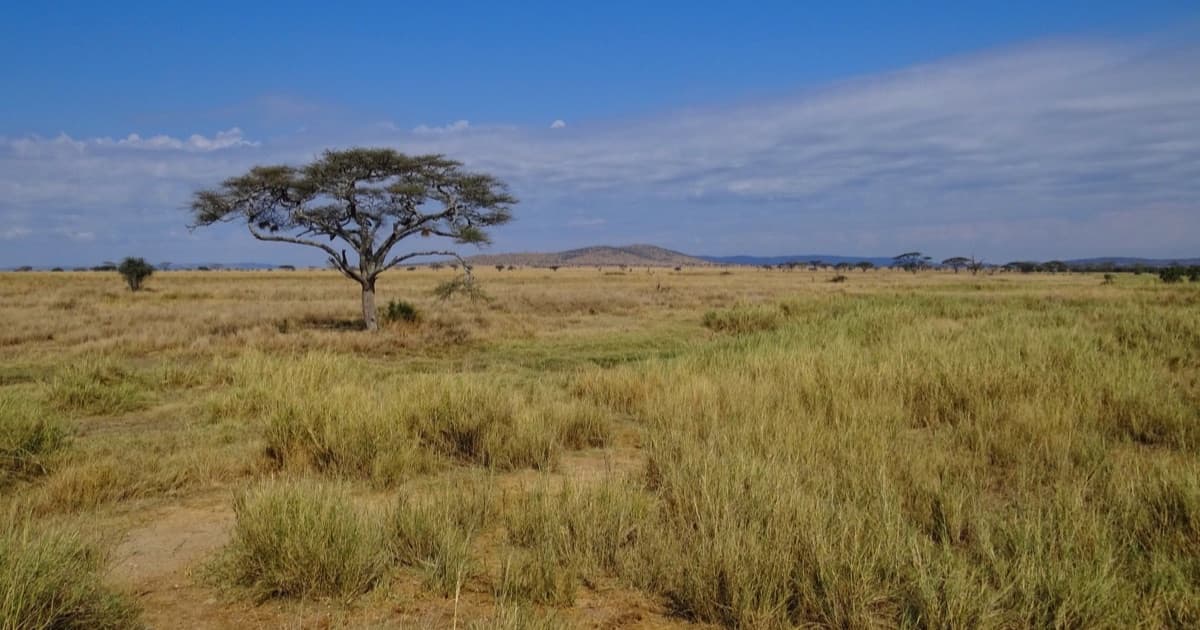
Which is better, the Serengeti or Ngorongoro Crater?
Neither park is objectively better. They deliver fundamentally different safari experiences, and which one suits you depends on your time, budget, and what you actually want to see. Ngorongoro is compact, concentrated, and almost guaranteed — you descend into a 260-square-kilometre volcanic crater where animals have nowhere to go. The Serengeti is vast, unpredictable, and extraordinary — 14,750 square kilometres of open plains where the world's largest wildlife migration plays out across all twelve months of the year.
If you have one day, go to Ngorongoro. If you have a week, the Serengeti becomes essential.
What makes Ngorongoro different
The Ngorongoro Crater is a caldera — a collapsed volcano whose steep walls act as a natural enclosure. Animals can leave, but most don't. The result is one of the highest wildlife densities anywhere in Africa, concentrated inside an area roughly the size of a small city.
A single game drive on the crater floor typically yields lions, elephants, zebra, wildebeest, hippos, and flamingos on Lake Magadi. The black rhino is the reason many travellers come specifically to Ngorongoro: it is the only place in Tanzania where a sighting is close to guaranteed. Rhinos have been functionally extinct in the Serengeti since the 1980s.
The experience is intimate and almost theatrical. You descend early in the morning, spend the day moving between soda lake, grassland, and forest edge, and return up the crater wall by late afternoon. Most visitors need one full day. Two nights in the area is the standard recommendation — one to acclimatise, one for the crater descent.
The crater floor requires a licensed guide hired at the main gate. This is not optional and costs $50–70 per day, paid separately from your entry fees. Factor it into your budget before you arrive.
What makes the Serengeti different
The Serengeti is not one place — it's a system. The park covers five distinct zones, each with different terrain and different wildlife concentrations depending on the time of year. Understanding which zone you're in, and when, is the difference between an average safari and an exceptional one.
Southern Serengeti (December–March): The calving grounds. Up to 8,000 wildebeest calves are born per day during February. Predator activity is intense — cheetahs, lions, and hyenas hunt openly on short grass. This is the most underrated window in the entire Serengeti calendar.
Central Serengeti (April–June): The herds move north. Kopje rock formations in the Seronera Valley hold some of the highest leopard densities in the park year-round. Seronera is the most reliably productive zone for big cat sightings regardless of season.
Northern Serengeti and the Mara River (July–October): The famous river crossings. Wildebeest and zebra pile into the Mara River in chaotic, dangerous masses — crocodiles waiting below. This is what most people see in wildlife documentaries. It's real, it's dramatic, and the camps along the river book out 6–12 months in advance.
The Serengeti also has something Ngorongoro cannot match: space. Game drives feel like genuine wilderness. You can drive for an hour without seeing another vehicle in the right zone and season. The sense of scale — horizon-to-horizon plains, sky filling the windscreen — is unlike anywhere else on the continent.
Which park wins for each type of traveller
Choose Ngorongoro if:
- You have 2–3 days in the northern circuit and need reliable wildlife
- You want to see a black rhino — it's your best chance in Tanzania
- You prefer a dramatic, defined landscape over open plains
- You're travelling as a couple or small group and want maximum sightings per day
Choose the Serengeti if:
- You have 4+ days and want to immerse yourself in genuine wilderness
- The Great Migration is on your list — river crossings, calving season, or both
- Big cats are a priority: the Serengeti's cheetah and leopard viewing is superior
- You want the classic, iconic African safari experience
Visit both if:
- You have 7+ days — this is the standard northern circuit and the right call for most first-timers
- You want to see both the guaranteed density of the crater and the scale of the plains
- Budget allows: adding Ngorongoro to a Serengeti trip typically adds one night plus the crater fees
What does each park cost?
Park fees are paid per person per day and don't change by season.
Serengeti National Park: $83 per adult per day (non-resident, inclusive of 18% VAT). This is a 24-hour fee — you can time your entry to maximise value. Entering at 4pm gives you the rest of the afternoon plus a full following day before your fee expires.
Ngorongoro Conservation Area: $60 per adult per day plus a $40 vehicle entry fee. If you descend to the crater floor — which you should — add $295 per vehicle for the crater descent permit. For a couple in one vehicle, that $295 is split between two people. For four people, it's split four ways.
The crater descent fee catches many travellers off-guard. It's per vehicle, not per person, which means couples pay significantly more per head than groups of four or six. If you're travelling as two, consider whether your operator can arrange shared crater access with another small group on the same day.
On top of fees, the mandatory crater guide adds $50–70 per day. This is the single most frequently forgotten cost in Ngorongoro trip planning.
For a full cost breakdown across both parks combined with accommodation tiers, use the Safarani safari cost calculator — it shows the exact per-person daily cost for your group size.
How much time do you need?
Ngorongoro: Two nights minimum. One night gives you a rushed crater morning. Two nights means a full crater day plus time to explore the rim drives and Olmoti or Empakaai craters if you want more.
Serengeti: Three nights minimum; four is better. One night gets you two game drives and a basic feel for the park. Three or four nights lets you cover multiple zones and genuinely increase your odds of exceptional sightings. If you're visiting for the Mara river crossings, allow at least three nights near the northern Mara region — crossings happen on the wildebeest's schedule, not yours.
Both together: Six to seven nights covers the full northern circuit comfortably. A typical flow: fly into Kilimanjaro, one night in Arusha, two nights Ngorongoro, three nights Serengeti. Add Tarangire at the start (excellent in October) for a fuller trip.
Can you do the Serengeti without a guide?
Yes — the Serengeti road network is open to self-drivers who follow marked routes between sunrise and sunset. No guide is required inside the park. The Ngorongoro Crater floor is the exception: the licensed crater guide is mandatory and cannot be skipped.
The honest answer for first-timers
Most first-time visitors spend too little time in the Serengeti and too long wondering whether to visit Ngorongoro. The crater is genuinely extraordinary — a day there is unlike any other safari experience. But the Serengeti is what people picture when they picture Africa, and three or four days there is what turns a good safari into an unforgettable one.
If budget forces a choice between the two, the Serengeti wins on sheer scale and repeatability. If time forces a choice, Ngorongoro wins on efficiency and guaranteed sightings.
The best answer is always both. The northern circuit exists because they complement each other perfectly.
Browse operators who cover both parks and message them directly on Safarani — no booking fees, no middlemen.