
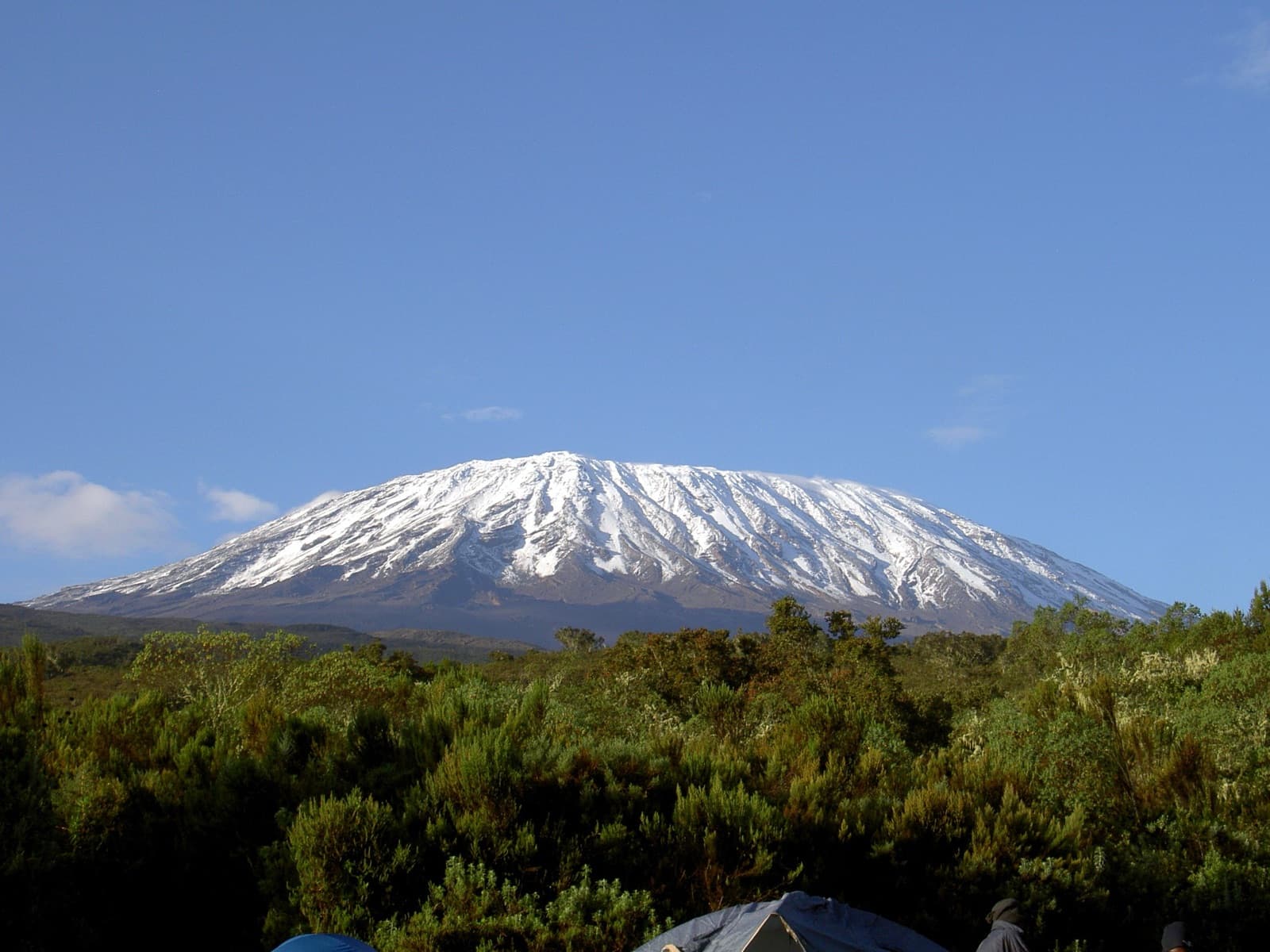
6-Day Kilimanjaro Marangu Route
Climb Africa's highest peak on the 'Coca-Cola Route' — the most accessible path to Uhuru Peak
Day-by-Day Itinerary
Day 1 — Marangu Gate (1,830m) to Mandara Hut (2,720m)
Register at the Marangu Gate and begin the climb through dense montane rainforest — colobus monkeys and hornbills in the canopy above. The forest is cool and shaded, the trail well-marked. Reach Mandara Hut in 3–4 hours. The A-frame huts sleep four, with a separate dining hut and basic toilet facilities. Acclimatise with an afternoon walk to the Maundi Crater viewpoint.
Mandara Hut (2,720m) — shared A-frame huts
Day 2 — Mandara Hut (2,720m) to Horombo Hut (3,720m)
Climb out of the forest into the moorland zone — giant heather, groundsels, and lobelias create a surreal landscape unlike anything below. The moorland is often misty in the morning, clearing by noon to reveal Mawenzi Peak rising dramatically ahead. Arrive at Horombo Hut in 5–6 hours. Kilimanjaro's iconic snow cap is now clearly visible on clear evenings.
Horombo Hut (3,720m) — shared A-frame huts
Day 3 — Acclimatisation Day at Horombo
A rest and acclimatisation day is built into the 6-day itinerary at Horombo — critical for summit success. The rule is "climb high, sleep low": hike up to the Zebra Rocks (4,000m) in the morning and return to Horombo to sleep. This acclimatisation hike is one of Marangu's advantages over shorter routes and significantly improves summit success rates.
Horombo Hut (3,720m)
Day 4 — Horombo Hut (3,720m) to Kibo Hut (4,700m)
Cross the lunar "Saddle" — a high alpine desert plateau between Mawenzi and Kibo peaks. The landscape is barren, windswept, and other-worldly. Arrive at Kibo Hut early afternoon. Eat dinner at 5pm and attempt to sleep by 7pm — midnight comes quickly. Altitude headache is common here; stay hydrated and take Diamox if prescribed.
Kibo Hut (4,700m) — dormitory style
Day 5 — Summit Night — Uhuru Peak (5,895m) — Descend to Horombo
Wake at midnight. The summit push begins in darkness on steep volcanic scree — Gilman's Point (5,756m) is reached at dawn after 5–6 hours of climbing. Continue along the crater rim to Uhuru Peak (5,895m), the highest point in Africa. The sunrise from the summit is extraordinary: the curvature of the earth visible, glaciers glowing pink, the shadow of Kilimanjaro stretching west for hundreds of kilometres. Descend all the way to Horombo for the night.
Horombo Hut (3,720m)
Day 6 — Horombo Hut — Marangu Gate — Moshi
Final descent through the moorland and back into the forest. Legs are tired but spirits are high. Register at the Marangu Gate, collect your Kilimanjaro summit certificate, and transfer to Moshi for a celebratory meal. The 'Kilimanjaro beer' at a Moshi restaurant has rarely tasted better.
Moshi hotel (own arrangements)
Included
- ✓KINAPA park fees and rescue fee
- ✓Professional lead guide and assistant guides
- ✓Porters (1 porter per climber)
- ✓Hut accommodation (Kilimanjaro Huts — beds, blankets, mattresses)
- ✓Full-board meals on the mountain
- ✓Kilimanjaro certificate upon summit
- ✓Transfer from Moshi to Marangu Gate and return
Not included
- ✗Flights to Kilimanjaro Airport (JRO)
- ✗Hotel nights in Moshi before/after climb
- ✗Travel and medical insurance with emergency evacuation
- ✗Gratuities for guides and porters (customary)
- ✗Personal trekking gear (poles, sleeping bag, boots)
- ✗Diamox altitude medication (consult your doctor)
Frequently Asked Questions
What is the success rate on the Marangu route?
The 6-day Marangu route has a summit success rate of approximately 60–70% — higher than the 5-day version. The acclimatisation day at Horombo (Day 3) makes a significant difference. Lemosho and Machame routes, at 7–8 days, have higher success rates (~80–85%) due to more acclimatisation time, but are harder and more expensive.
How much does it cost to climb Kilimanjaro?
The 6-day Marangu route costs approximately $1,400–$2,500 per person depending on group size and operator. This includes park fees (~$800 USD in fees alone), guides, porters, and hut accommodation. Budget operators start around $1,400; reputable mid-range operators charge $1,800–$2,200. Luxury options with private camping and gourmet food run $3,500+.
Do I need to be a professional climber to summit Kilimanjaro?
No technical climbing is required — Kilimanjaro is a trek, not a technical climb. Good physical fitness is essential: the ability to walk 6–8 hours per day for multiple days, carrying a daypack. The main challenge is altitude. Begin training 3 months before with long hikes. Anyone reasonably fit who follows the guide's pace and is properly acclimatised can summit.
What should I pack for a Kilimanjaro climb?
Key items: hiking boots (broken in), warm sleeping bag (-10°C rated), waterproof jacket and trousers, thermal base layers, fleece mid-layer, thick hat and gloves, trekking poles, headtorch with spare batteries, sunscreen SPF50+, sunglasses, 2-litre water reservoir or bottles, high-energy snacks. Soft duffel bags only (no hard cases) for porters. Full packing list available from your operator.
Is the Marangu route the best route up Kilimanjaro?
Marangu is the most affordable route and the only one with hut accommodation (important in bad weather). However, it is also the most congested route and has a lower success rate than Lemosho or Machame due to its shorter acclimatisation profile. For first-time climbers on a budget, Marangu is a solid choice. For those prioritising summit success and a quieter experience, Lemosho or Machame are preferable.
Ready to book this trip?
Contact a verified Tanzania operator who covers these destinations. All operators on Safarani are independently reviewed.
Find operators →Destinations on this itinerary
Estimate your total cost
Use our free safari cost calculator to break down park fees, accommodation, and transport for your group.
Open calculator →